Next-Gen Social App
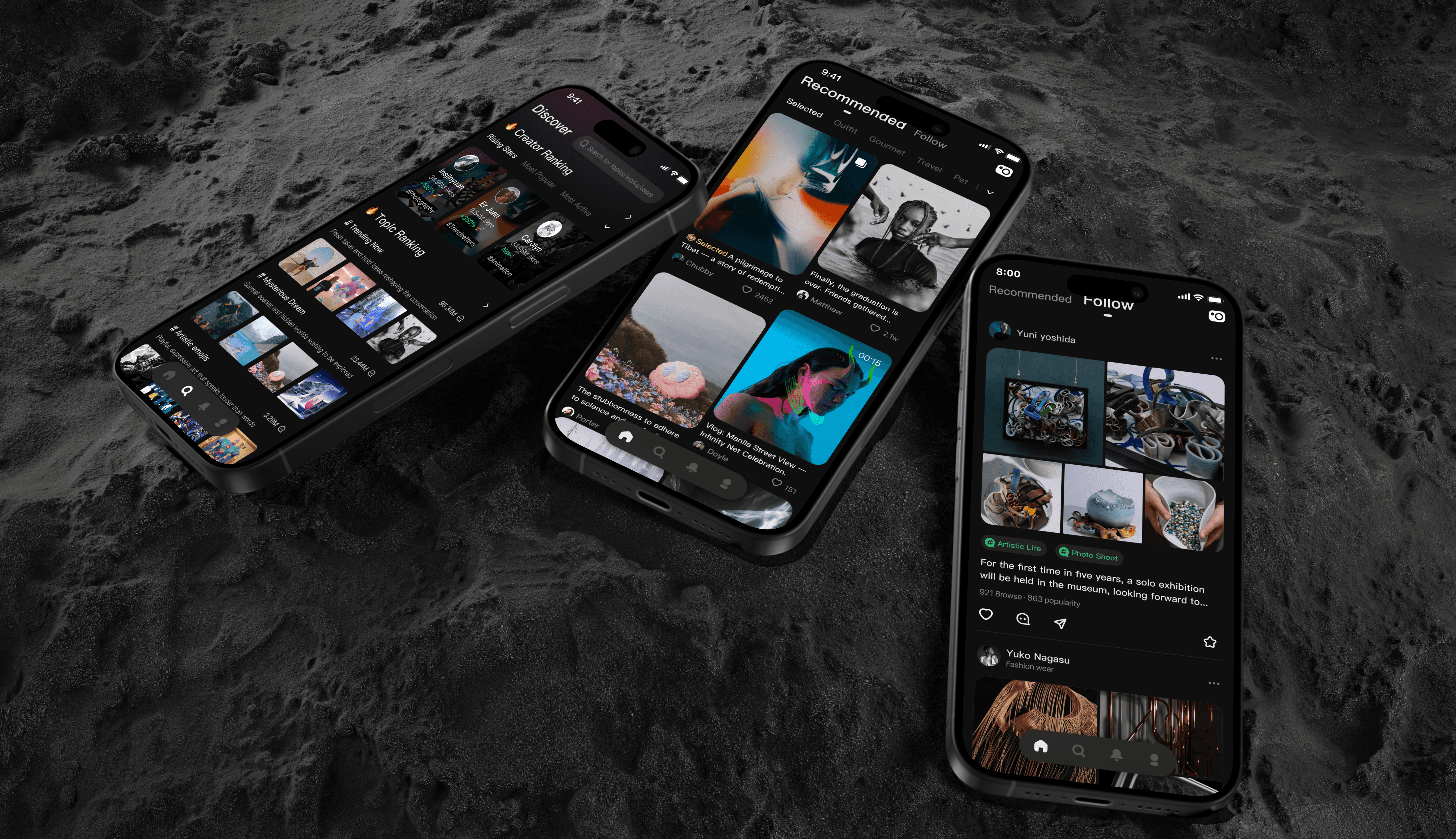
I led end-to-end product design for Before, a content-driven social app for 16–35 year olds in urban China. In a market already dominated by TikTok/Douyin and other content platforms, our team had just 7 months to define a differentiated direction and launch the product on iOS and Android. My work covered user research, UX/UI design, and branding/marketing design, with a focus on helping users move from passive browsing to meaningful community connection.
My role
Product designer
Duration
Nov 19 - Dec 20
Tools
Figma, Asana, Testflight, PS
Team
2 designers, 4 PM, 9 Engineers, 5 Markteters
|
Community-First Home Experience
Create a home experience that helps users quickly find content and communities relevant to their interests. With For You for personalized content and Explore for deeper discovery, the experience moves users from casual browsing to a stronger sense of relevance and belonging.
|
Relationship-Driven Interaction
Turn passive browsing into relationship building by guiding users from followed content, to lightweight public comments, and eventually to private messages. This gradual flow lowers social pressure, builds trust, and supports long-term engagement.
|
Lower-Friction Content Creation
Make posting easier by simplifying the creation flow and reducing complexity. Features like suggested tags and visibility settings help users share more confidently, encouraging more frequent and diverse participation.
Most Memorable Moment:
Designing for belonging in an oversaturated market
One of the most memorable parts of this project was turning a vague business ambition into a clear product strategy under extreme time pressure. We were entering a crowded category where most platforms already competed on content volume, entertainment, or celebrity-driven discussion. Through research, we uncovered a more human opportunity: users did not need more content—they needed recognition, emotional safety, and easier ways to connect. That insight reframed the entire product around a simple journey: Discover → Connect → Deepen.
Seeing that strategic direction influence the home feed, exploration model, messaging system, and later growth loops was the moment the product started to feel genuinely different. This was the turning point that transformed Before from “another content app” into a community-first social experience. This title and framing are an inference based on the project narrative on the page.
|
Impact
What We Achieved
Building a community-first social app in a content-saturated market
Strategic thinking
Cross-functional Collaboration
Adaptability
Systems Thinking
|
Section 1
Finding the opportunity through research
User Research
Competitive Analysis
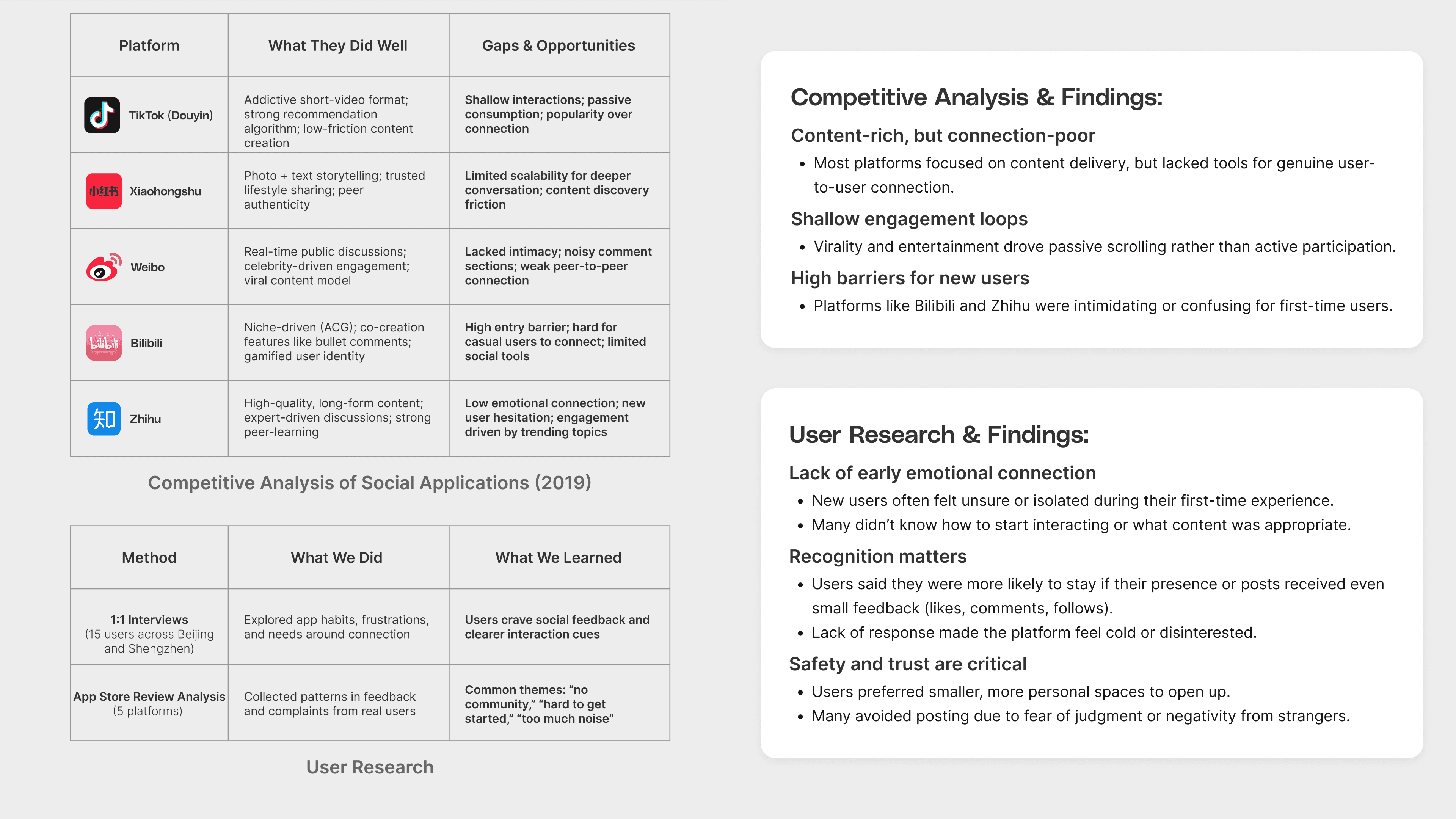
We started by looking at the market from both a product and human perspective. Competitive analysis showed that many platforms were strong at content delivery, but weak at helping people form genuine user-to-user connection.
At the same time, user research revealed that first-time users often felt uncertain, isolated, and unsure how to participate. Small signals of recognition—such as likes, comments, or follows—mattered more than expected, while fear of judgment made many users hesitant to post at all.
These findings helped us define the real opportunity: instead of competing on pure entertainment or virality, Before could differentiate by making people feel welcomed, seen, and socially safe from the beginning. That shift gave the team a sharper strategic direction and became the foundation for later design decisions across discovery, messaging, and creation flows.
|
Section 2
Turning strategy into product structure
Dealing with ambiguity
Interaction Design
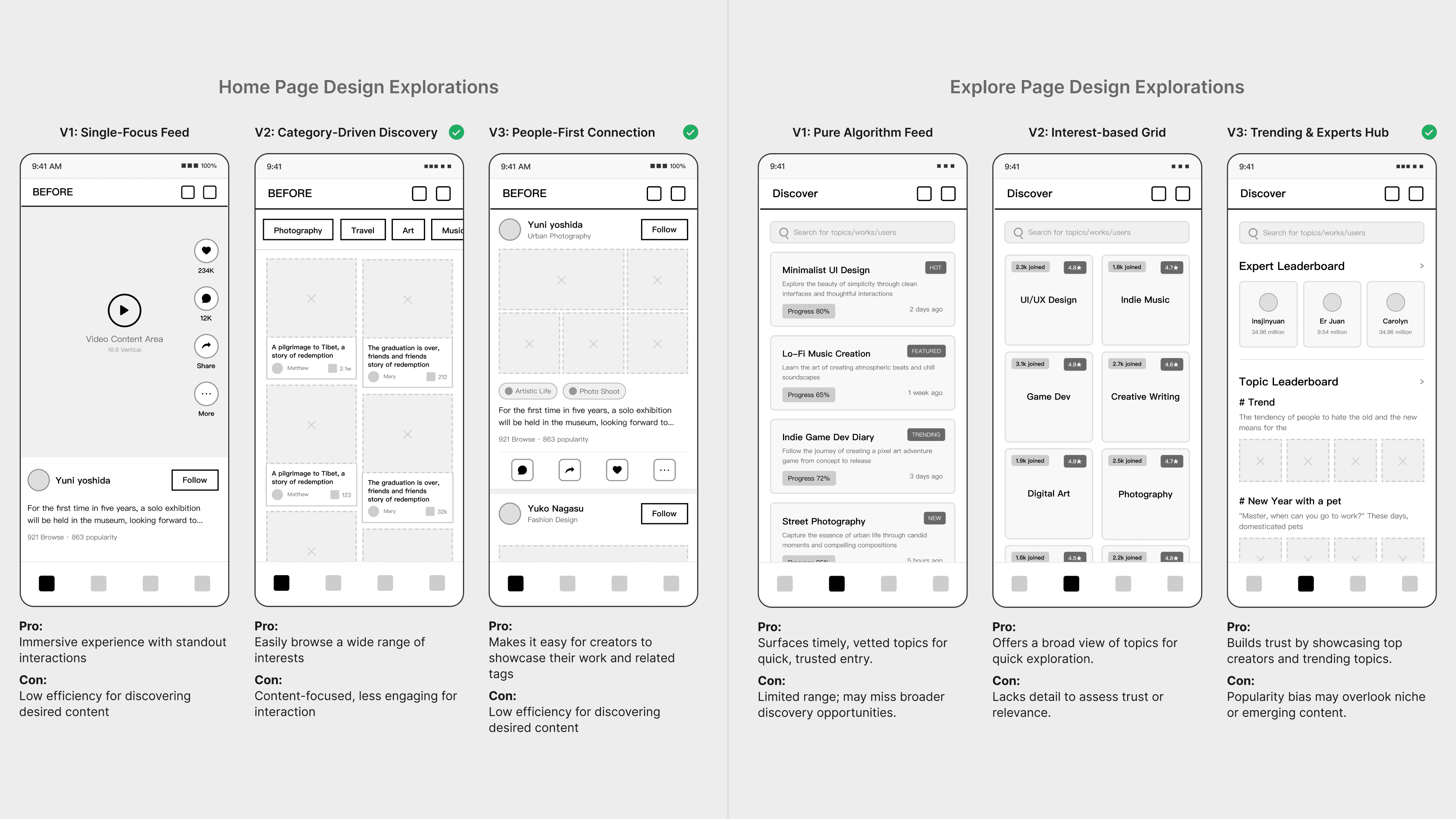
Once we had clarity on the problem, the next step was translating that insight into a product structure people could actually feel. We framed the experience around Discover → Connect → Deepen, then tested how each core surface could support that journey. On the home page, we balanced curated exploration with relationship-building through Recommend and Following. On the explore page, we shifted discovery toward communities and trusted spaces instead of endless passive scrolling. In messaging and profile design, we built a system that supported both public and private interaction, giving users more control over how they connected. Across all of these decisions, the design goal stayed consistent: lower the emotional barrier to participation and make the platform feel less cold, less noisy, and more personally relevant. The work was less about adding features and more about aligning the whole experience to one social principle: belonging drives engagement.
|
Section 3
Improving behavior through testing and iteration
Usability Testing
Data-driven Iteration
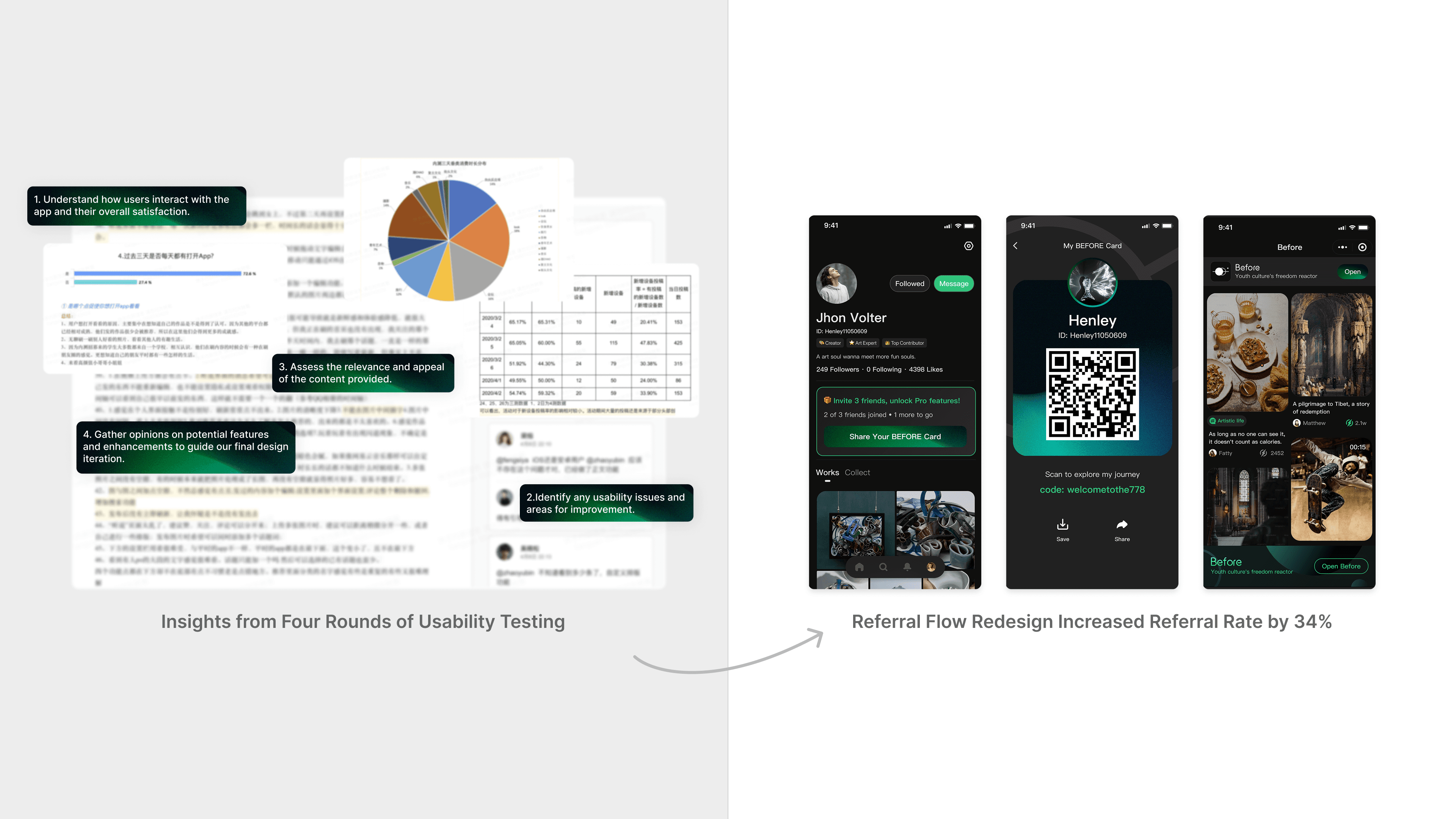
After the initial design direction was set, we ran four rounds of unmoderated user testing and continued refining the product using behavior data. This phase made it clear that building community also meant reducing friction. We discovered that content creation intimidated many users, with a 54% drop-off during the posting flow, so we simplified creation, added suggested tags and visibility settings, and made editing feel more guided and approachable. We also noticed that growth through social connections was far stronger than app store discovery, which led to a better referral system with personalized sharing cards, QR codes, and consistent cross-channel branding. In parallel, creator ranking and progress tracking were introduced to motivate more participation. These changes drove measurable gains in creator activity, retention, and referrals, proving that small UX improvements could compound into stronger community growth.
|
Projects
|